Associations

Perhaps I’ve touched on this before, but it follows on from last time. I was driving to work the other day when “Georgia” by Boz Scaggs came on the radio. Within a few bars I was a blubbering mess, not because the song held any special significance for Ngaire’s and my relationship, but because it was a song from an album that evoked the era in which we established our love for each other. In fact, the album was released that very year. They were the years of our late teens, full of passion and life, with the world and our destinies before us.

The first night that we went out together – May 3rd, 1976 – I brought her back to my parents’ place for coffee (they were overseas at the time). As we sat at the kitchen table, I recall so clearly that we both felt that a sudden shift had taken place in our reality and we were each staring into the eyes of the one we would spend the rest of our lives with. It was an amazing, profound evening.

It was also a time of powerful emotions forging the foundations of our lives together, and a time of great music. I did a bit of a web search and compiled a far-from-exhaustive list of artists from that era. When I saw the names and remembered the great music, it kind of made me understand why so many of us old-timers are a little underwhelmed at the general state of music these days. Look at these names of the ‘70’s:

Bob Marley, The Pretenders, Roxy Music, The Doobie Brothers, Boston, Neil Young, Carly Simon, John Lennon, George Harrison, Elvis Costello, Elton John, Thin Lizzy, Queen, Fleetwood Mac, Santana, Blondie, Deep Purple, Rolling Stones – in their 2nd decade, Gladys Knight and the Pips, Rod Stewart, Marvin Gaye, Led Zeppelin, B-52’s, Abba, David Bowie, AC/DC, Bruce Springsteen, Stevie Wonder, Pink Floyd, Talking Heads, Wings, Michael Jackson, The Ramones, Donna Summer, James Taylor, The Knack, Jackson Browne, Billy Joel.

As I sobbed my way through the traffic, it didn’t help to drift in my mind from song to song of that era that I won’t be able to hear again without the associations of that love, passion and life that put their indelible stamp on so many great tunes that we listened to over and over. Now that she is gone, the intimacy of those associations is no longer shared; the memories that each evokes are now mine alone, and it underscores the loneliness and loss.

Of course, music has an incredible ability to evoke memories. My parents’ “song” was Moon River and even now, many years after they have gone, I find myself drifting into melancholy whenever I hear it.

Smells are the same. Ngaire had a favourite expensive Estée Lauder perfume that she wore on our first date. I bought it for her from that time on; she never ran out. Someone wore it the other day in a shop in North Sydney and I made a hasty exit, choking back an involuntary sob.

I must sound like I’m crying all the time, but it’s only these moments now, although they do have a way of hitting when I least expect it. And I’m sure that these associations will be the things that will make getting over losing Ngaire that much harder and yet, they are a tie that we alone shared and I don’t want to ever find that they become just another memory.

I bought the Santana album, Amigos right around the time that we first went out; our “song” was an instrumental, a powerful, majestic lead guitar break from the album called, Europa – Earth’s Cry, Heaven’s Smile. Strangely fitting……


In and Through

I went to dinner with some dear friends last night and, as we were leaving, Gary asked me when the next installment of this blog would appear. I said that I didn’t have anything to write about at the moment. As I drove home, I began to realise that it wasn’t true.

For people walking the road of grief and loss, I suspect the issue is not that there may be times when you have nothing to say, rather that you actually have a lot to say, but not the words. This surely is an aspect of the deep pain.

I went to sleep reasonably early but woke just before 2.00 a.m. This is not entirely uncommon, but I was hoping for more rest than three and a half hours. As I tried to get comfortable, I made a small, gentle movement with my hand to draw the sheet closer to my chest. I suddenly became aware of it being a “Ngaire” movement. Maybe this sounds odd, but I felt it to be one of those “the-two-shall-become-one” moments that I have talked about before. When such things happen, I find that I am instantly undone, hence sitting writing this now at 3.33 a.m., after too long of trying to get back to sleep.

You see, what I am finding about grief is more along the lines of what C.S. Lewis said in A Grief Observed: “No one ever told me that grief felt so like fear”.

In the dark hours particularly, the loss feels like a deep, penetrative disturbance in my being that has no ready connection to the rational. I become anxious, a little unsettled in the stomach – like Lewis, I keep on swallowing – I have to get up; to try to sleep is utterly pointless. I quote from my journal of September last year:

In terms of my identity and the things that drive me, my compass has her as north. I live to please her, to make her happy, to have her respond to me. For that to be gone would be to lose my reason to exist. I suspect that that is why grief feels like fear, because it is; and it is a dark, unholy place.”

Such moments have become less over the last while. Strangely, they were more common in the year before Ngaire died. Her condition was so perpetually confronting that no matter how brave I appeared on the outside, within was a soup of confusion, dread and fear mixed with hope and, of course, love. The grieving began long before she went.

In contemplating the vast ocean of humanity that has suffered in grief as I, my boys and Ngaire’s close family and friends are now, I feel quite insignificant in the context of history. Despite what the humanistic self-theorists say, despite what the preacher may tell us about our importance, there is a vital understanding in this “insignificance.”

The reality is that, in this world of seven billion people, we are very small; beyond our family and the worlds of those who love us, we are, most of us, of little consequence. The author, Henri Nouwen calls it “smallness”. I like that because it is in this smallness that help arrives, if we ask for it. He goes on to say that only when we invite God in to the pain can we live fully through it. That is one of the reasons I write this blog: to engage with God in the pain to find the right way through it. As Nouwen says, “The way out of grief is in and through.”ı

In our western world, we have highly developed systems and processes designed to help us avoid pain. Consequently, our learned tendency is to deny, avoid, suppress and medicate. Sadly, all we have ended up with is a society that is largely unprepared for many aspects of life; unpleasantness and the tough stuff of relationships are often ignored or left unresolved until the pile of crap becomes too high. Then, we decide, it’s time to move on. “I don’t love you anymore” or “you’re not the person I married” are some of the ways we speak out our justification for not engaging in life.

We also “medicate”. Believe me, I know about this one. Sadly, we think that all we are doing when we use medication is numbing the pain. But, as social researcher and speaker, Brené Brown says, you don’t just numb the pain; you numb everything2: your ability to love, experience joy, build caring relationships and empathise. Whatever your drug of choice is, from alcohol, through to prescription drugs and even food, you numb your ability to be in life.

Don’t get me wrong; I’m not being a wowser. Those of you who know me will know that’s definitely not the case. All I’m saying, from bitter experience, is when you use anything as a means of numbing the pain, you also numb your ability to engage in life, with all of its beauty and ashes.

Anyway, that was a very protracted way of saying that I am discovering that the best way out of this pain is in and through. Of course, I’ve had times of drinking too much, as a means of escape, but it is not my ongoing mode of operation. I want to get this right. Maybe what this whole thing is saying is, we only get one shot at this life, so for our sake and the sakes of those who love us, let’s do it right.

Thus endeth the sermon. One thing I wanted to add for those of you who might be going through something similar, is that because of the long period of grieving over the last couple of years, I feel that the grief itself is diminishing somewhat; the dark times are not so regular, and now the issue for me is one of loss. My precious one is gone.

I have started making a list of things that I miss about Ngaire and have found it difficult, poignant, beautiful, funny and heart-rending. I want to share some with you:

Things I miss about you


–             Seeing you in the morning sun, looking out on the beauty from our bedroom window

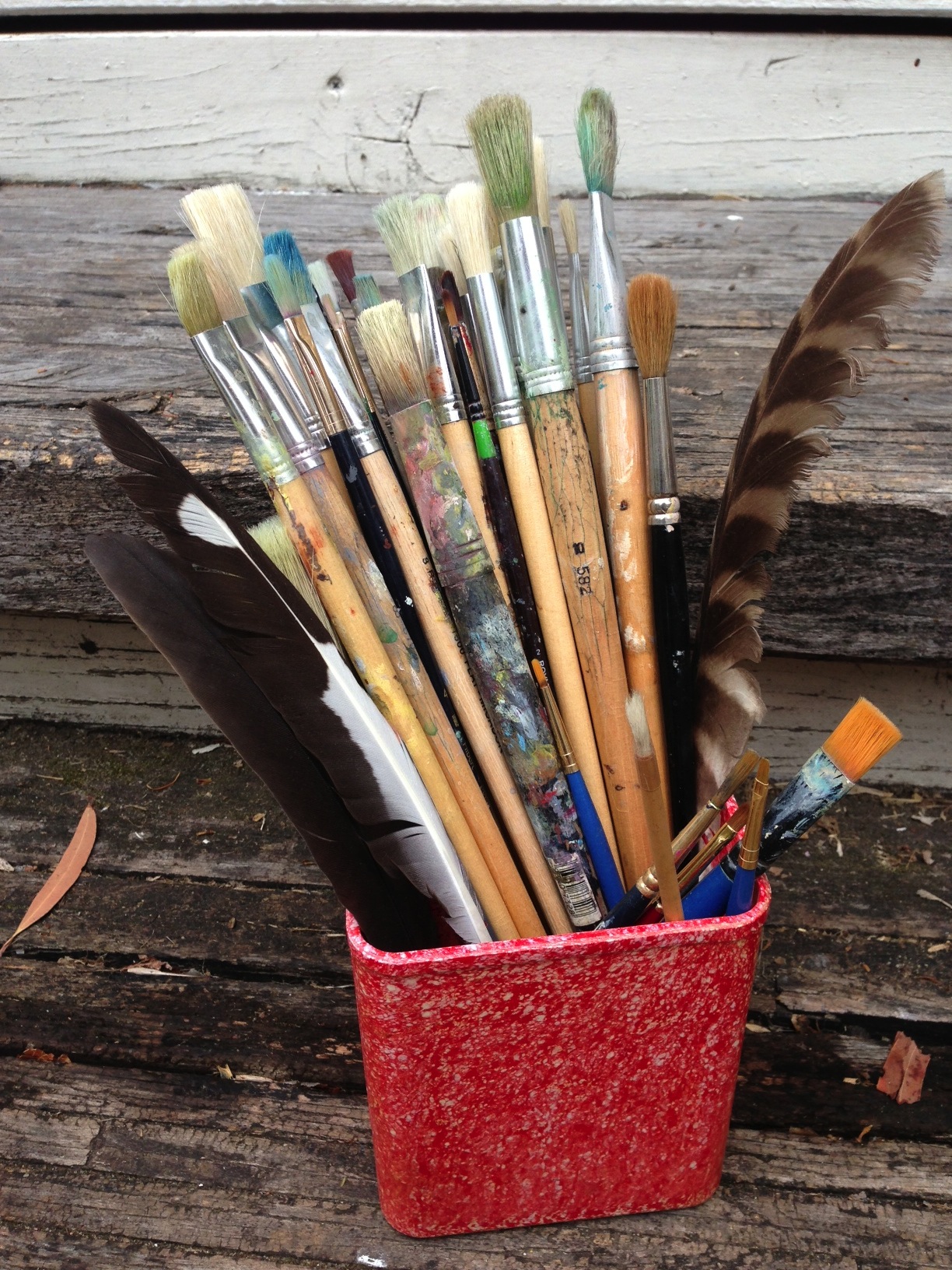
–                    Watching you paint in your studio, while I write

–                    Making you cups of tea that you never finish

–                    Standing, holding you

–                    Finding things that you mislaid

–                   Making you fresh bread and mortadella sandwiches with tomato sauce and you, every time saying, “Oooh, my favourite!”

–                    Your beautiful thoughtfulness

–                    Praying for our boys together

–                Ringing or texting whenever I see something that I know you would love or be interested in.

–                    Your cute sketches of things that you’re trying to describe.

–                    Sharing chocolate-covered aniseed rings

–                   Putting my hand on your leg while driving, and you putting your hand on mine

–                    Looking into your beautiful eyes

I don’t suppose the list will ever end.

ı Henri Nouwen, Turn my Mourning into Dancing

2 Brené Brown, The Power of Vulnerability

Condolences

Condolence – noun – an expression of sympathy with a person who is suffering sorrow, misfortune or grief.

It’s a strange word and one that you don’t usually hear at any other time. That’s one of the things that I love about English; you can have a hundred words that are nuances of basically the same thing, but, usually, if you really need it, there is also a word that means exactly what you’re looking for.

“My sincere condolences….”

It sounds so formal and unnatural, probably because everything about death and loss is so foreign to how our lives are structured. I have had many different expressions of sympathy from many people over recent weeks. All have been appreciated. It’s interesting, though, that the ones that “touch” deepest are the simple ones. A mate said to me the other night, “I really have no idea how you must be feeling. I cannot comprehend it, but I am so sorry.” Oddly enough, that meant so much more to me than someone who may be offering comfort from a philosophical/ideological/spiritual viewpoint. Not that those aren’t appreciated, it’s just that, before Ngaire died, I had my own viewpoint, which would, in many ways, have looked or sounded just like many of the expressions that I have received. But really, my mate was right.

Along this road, I have experienced a lot of death. The ones that touched deepest were, of course, those closest: my mother, father, and before Ngaire, my brother’s death was the most devastating. However, though Ngaire’s passing was a possibility that was never far from my thoughts over much of the last few years, there is no comparison with anything that I have experienced before.

“….and the two shall become one flesh.”

There’s the difference; the other losses were just that: tragic losses. But this is like a disembowelment of the soul, the sundering of a union formed at the deepest level of being, so there are not many words that can come close to easing that. I also feel ashamed that I have been oblivious to the pain that those friends and loved ones who have lost partners must have endured. Then again, how could I possibly have known?

I am honoured that people have bravely ventured into that territory with us, though. Some have written letters, cards, sent emails, flowers, boxes of fruit, delivered meals, invited us for meals – so many expressions of love, for which I am immeasurably grateful and which have been a balm. In fact, without them, this journey would be bleak and dark indeed. Thank you.

As time draws the slow separation which gradually begins to make the loss manageable, the staggering and daunting realisation is that there is no going back; everything is new, and life – lives – must be rebuilt. I left a friend’s place last night, after dinner and, as I went over the evening’s conversation, began to fashion in my mind how I would tell Ngaire about it when she came home……but that will have to wait.

Here’s a poem about another aspect of life now:

The Estate

  Apparently now you have an estate,

Or so some letters are addressed.

They want to tidy things up

While I want to keep things going.

But when I read your name on other dispatches

From The Chamber Orchestra, the Art Gallery

Or even the bank, it tells me that you are

Still here, still interested and full of life.

The Art Store, the Fabric Store tell me

That you are still creating, flowing in love

Living in all that meant so much to you

And others, not silenced

But juvenescent, absorbing journals

And how-to mags, always thinking

How to bless, honour, bring joy

Through word, gift or effort.

Those who received show where

Your true estate lies; those whose

Lives were changed, enlightened,

Warmed are those who, part of the larger

Domain of grace and light, walk now on land

Reclaimed, with hearts imbued

With hope and worth, who feel the loss,

Not as that to be tidied, but as a precious seed.  

Image